Lenka, the Australian songstress, is just a little bit caught in the middle. Like all of us. Just enjoy the show, she implores.
The video shows us a young singer, who smiles coyly at the camera as she is summarily jerked around by an unseen hand, moving her into and out of the situations of daily life.
This is probably how it feels when one is at the center of a media campaign like the one promoting her debut album, Surprise. But is she really promoting the kind of passivity depicted in her music video?
Certainly, this is an idea with its supporters: Buddhistic withdrawal from the world is, I think, a kernel shared by many religions. It's what allows for the Christian capacity for suffering. And there is no doubt that it is a useful tactic at times when one cannot affect the world around them. At some point, everyone needs to learn that there are things they can't change.
But let's not forget that it's this passivity which allows the great injustices of the world to continue: without it, would the serfs of Europe supported the rulers of Europe through the middle ages? Would the caste system have flourished so long in India? It seems to me that the current citizens of the world are already quite good at passivity: it is the implicit message of the television medium, and most of us have been indoctrinated by it from an early age; this culture of passive media consumption has been extended out of the home by the iPod. Lenka, it would seem, is preaching to the choir, through iTunes.
I should mention that it's an idea with which I've never been entirely comfortable. This world may well be a false one, as the Buddhists and Gnostics have it, but nevertheless it's the one in which we live. To completely embrace passivity is to give up on the possibility of improving the world for future generations, which seems irresponsible to me. It should be possible to live within the ethical and spiritual guidelines of a religion and also deal responsibly with the problems with which we are daily faced in this world.
The song happens to be a fairly inspired bit of pop candy, aside from a nagging similarity to Avril Lavigne's "Complicated." But the lines are longer here, lilting easily into the choruses; the melodic resemblence only serves to make it even catchier. The material is also easier to take without the superficial dressing of teen angst and watered-down punk. One wonders if Lenka is giving us a hint that she knows what she's doing as she emphasizes the word "pop" in an early verse.
Throughout the video she is mostly passive; at one point, however, she reaches out and holds on to a microphone as the unseen hands lift her from the stage, delaying her exit for a few lines. This, and a certain slyness in her smile as she mugs for the camera, makes me wonder if she's as dedicated to utter passivity as her lyrics might suggest. She might be enjoying the show now, but I would imagine that she's worked very hard to put herself into the middle of this media blitz; still, there's not more than a hint of sarcasm or wit in this confection. We'll see how long it lasts.
I've been reading about pop music for the past hour or so, and I'm starting to feel a bit unwell. Here's a some footage of Django Reinhardt to clear the palette.
Thursday, September 18, 2008


Wednesday, September 17, 2008
Lindt Excellence Chili
 As you know, I am a dedicated corporate shill, and now I must once again ply my trade.
(Ok, I'm kidding, but, I would be willing to accept donations even from corporate sponsors.)
This Excellence Chili stuff is fantastic. I think Lindt's Excellence line is pretty solid dark chocolate, not too bitter or waxy, maybe even a bit sweet for some. But they've hit the nail right on the head with this one: it's about 49% cocoa solids, and at first it comes off as sweet dark chocolate, even a bit creamy. At first bite you may be disappointed: this doesn't have the immediate, obvious spice of a Mexican hot chocolate with chiles.
The chili comes on slowly, as almost pure heat. Amazingly, it doesn't overpower the chocolate or push it off balance: in fact, it's hard to imagine a better balance.
It's the time factor that really makes this a treat: at first nonexistent, then subtle, finally palpable, the heat is a wonderfully nuanced addition that both highlights and enhances the chocolate. Highly recommended.
Tuesday, September 16, 2008
Get out of jail free
 Now that I'm here, more or less installed in my place in Täby, I have of course turned my attention back to the most important things in life, those topics which don't change simply because one moves to a new continent or begins a new chapter in life. Yes, I am back to analyzing the cultural impact of electonics.
Awhile ago, when we realized that we'd probably prefer not to bring our desktop computer to Sweden (a bit of a shame because it was a nicely-configured box which was serving us well) we decided to get another laptop. After much hemming and hawing, initially favoring windows machines because of their prices, Brett settled on a white Macbook, nearly identical to the one I bought last fall. In large part this was because of an available deal on Adobe's CS3 suite, but the proposition was also helped along by a back-to-school iPod giveaway.
So, earlier this summer, we found ourselves proud first-time iPod owners.
I'd avoided the iPod phenomenon for a few reasons: first, it was an expensive toy, and I generally enjoy hearing the sounds from the world around me. I tend to read while on public transit, and listening to music in addition makes one a bit too isolated for my taste. Second, it just seemed to popular. But this dabbler in HCI could hardly resist the temptation of getting a $300 toy for free -- the iPod touch, running the same OS as the iPhone.
Nor could I resist spending the $10 for the firmware 2.0 upgrade, allowing me access to the App Store, with a good selection of quality applications, including some solid free ones.
The iPod Touch in an impressive piece of hardware. It's even been handy while I was running around Stockholm without good internet access. But there are some serious caveats.
- Sure, you can render websites just fine, but you can't download files.
- No cut & paste. This is inexcusable on a device with this much power.
- No terminal app -- not even one that would only let you log in to remote devices.
- In fact, no real "root" access to your system.
But to realize this yourself, you need to jailbreak your device and see what you're missing. The best post-jailbreak features are actually low-level OS features that should have always been included on these devices: a terminal app, openssh (for logging into your iPod), netatalk (an AppleTalk server, so you can share files to it) and an extended preferences app, BossPrefs.
The jailbreak is free, and most of the stuff I just mentioned in GPL software.
Why do we have to hack our way into the devices we own? We're really just adding back in functionality that's been arbitrarily removed. Listen, iTunes, is a fine piece of software; it's got its detractors, but it's largely adequate. However, as a software platform, it sucks. I don't want to live in an iTunes world -- I want to live in the world where I have root access to my devices, and I can hack or break them to my heart's content. I also want to have the things that I've grown accustomed to, like cut & paste and, uh, the ability to save files.
So let's just do a little comparison, between the iPod Touch and the Nokia N810. The Nokia is basically an overgrown cell phone, running a modified version of Debian GNU/Linux. It's got a slide-out keyboard and a pen-touch screen. It's got GPS, and 2gb of storage. It's got wireless and an ARM processor, similar to the iPod Touch. The storage is expandable with a MicroSD card, so let's just say that the hardware is basically similar, with some interface differences.
So what is the difference? With the Nokia, you get less "sexy" factor, and instead, you get the ability to save files, cut & paste, and a terminal with root access. You basically get a PC in a small form factor. This blows the jailed iPod out of the water in terms of utility; a Blackberry does the same for the iPhone.
So why do we need to download a sketchy hack just to get this basic functionality? The only answer that I can imagine is that the Apple Touch devices are for entertainment only; Apple has no interest in creating a device with any real utility. Apple's profitability has come from one of the most vapid, useless products ever (the iPod) and this is the future that they want to pursue.
Apple: don't forget us, the power users and hackers. Listen, Steve: there is a reason that the Touch was my first iPod, and it wasn't because I need bigger cover art.
Monday, August 25, 2008
3.5 beer sucks
Sweden is a lovely country, with many fine features to recommend it, as I am discovering daily. Moving to a foreign country is hard. I could expound on both of these topics for awhile...but not today. Today I'd like to discuss a real and pressing problem with life in Sweden: the beer sucks.
This shouldn't have been a shock: most of the places I've been in Europe kinda suck when it comes to beer. The most famous beer from Sweden is Carlsberg, which, yes, also sucks. It's a light lager, just a tiny notch better than American crap beers from Anheuser-Busch & Coors. There is a general dearth of quality ale in this country; a real problem for a country with a long, dark winter.
But it's worse than that.
The Swedish control alcohol very closely -- all alcoholic beverages stronger than 3.5% alcohol are sold only at state-run stores called the Systembolaget. This means that at your local grocer, the only beer available is crap 3.5 beer.
Let me explain my objection: I couldn't care less what the alcohol level of beer is, as long as it's delicious. You can still get drunk on low-alcohol beer; it's what lots of people do, pounding can after can of Coors Lite or some other commodity product. It is, however, very hard to brew a flavorful, mouth-filling ale. Regardless of one's attitude towards alcohol, the sugar content of beer (the brewing term is gravity, I believe, from "specific gravity") which of course determines its alcohol content, is perhaps the main component of the beverage. It contains most of the caloric content, largely determines its mouthfeel, and is the main pillar around which a beer is built. Without sufficient alcohol, most beer styles cannot be achieved: no stouts (Guiness is a relatively low ~4.2% abv) no bitters (Fuller's is higher, at ~5.9%) and certainly no California-style IPA beers, where the massive hopping is only possible because of high alcohol content. Don't even think about Belgian-style dubbels and trippels.
Alcohol is a serious issue: alcoholism is tremendously problematic as a public-health issue, and I think we are all familiar with the possibilities on a personal level. And maybe the Swedish policy does, in fact, help. But it's very odd to come from California, where aside from the high drinking age, alcohol policies are lenient and continental: beer, wine and even spirits can be sold in grocery stores. Sweden, on the other hand, seems to have policies that are even tighter than Massachusetts -- aside from the easy availability of 3.5 beer. Which, by nature, sucks.
This shouldn't have been a shock: most of the places I've been in Europe kinda suck when it comes to beer. The most famous beer from Sweden is Carlsberg, which, yes, also sucks. It's a light lager, just a tiny notch better than American crap beers from Anheuser-Busch & Coors. There is a general dearth of quality ale in this country; a real problem for a country with a long, dark winter.
But it's worse than that.
The Swedish control alcohol very closely -- all alcoholic beverages stronger than 3.5% alcohol are sold only at state-run stores called the Systembolaget. This means that at your local grocer, the only beer available is crap 3.5 beer.
Let me explain my objection: I couldn't care less what the alcohol level of beer is, as long as it's delicious. You can still get drunk on low-alcohol beer; it's what lots of people do, pounding can after can of Coors Lite or some other commodity product. It is, however, very hard to brew a flavorful, mouth-filling ale. Regardless of one's attitude towards alcohol, the sugar content of beer (the brewing term is gravity, I believe, from "specific gravity") which of course determines its alcohol content, is perhaps the main component of the beverage. It contains most of the caloric content, largely determines its mouthfeel, and is the main pillar around which a beer is built. Without sufficient alcohol, most beer styles cannot be achieved: no stouts (Guiness is a relatively low ~4.2% abv) no bitters (Fuller's is higher, at ~5.9%) and certainly no California-style IPA beers, where the massive hopping is only possible because of high alcohol content. Don't even think about Belgian-style dubbels and trippels.
Alcohol is a serious issue: alcoholism is tremendously problematic as a public-health issue, and I think we are all familiar with the possibilities on a personal level. And maybe the Swedish policy does, in fact, help. But it's very odd to come from California, where aside from the high drinking age, alcohol policies are lenient and continental: beer, wine and even spirits can be sold in grocery stores. Sweden, on the other hand, seems to have policies that are even tighter than Massachusetts -- aside from the easy availability of 3.5 beer. Which, by nature, sucks.
Thursday, July 24, 2008
The iPod Age
Did 9/11 Prepare us for the iPod?
Autumn 2001 was a confusing season, full of upheavals. I don't need to remind you of the attacks that opened the current political age, but I may need to remind you of the stock market crash on the 17th of September, and the original name of the “Global War on Terrorism:” Operation Infinite Justice. In early October, the U.S. began operations in Afghanistan. On the 9th of October, the anthrax scare began. From the cool distance of nearly seven years, it's hard to remember the intensity of the hysterical, paranoid atmosphere which filled the aftermath of the attacks.It's also easy to forget the events of October 23rd, 2001, a day as important as any of these others (arguably more so) to the everyday life of the average American consumer. On this day, Steve Jobs made the original iPod announcement, heralding the age of the personal digital media player.
By mid-November, the telltale white earbuds had started popping up on the ears of early adopters around New York. It was always good to have a little extra entertainment in those days, in case your train was delayed up the track while the authorities investigated a mysterious package. Even better, these shoppers were doing their patriotic duty by spending their money on consumer goods, the cornerstone of the economy.
The iPod experience is that of a personal cocoon, separating you from your environment, wrapping the user in a personalized experience unshared by others in their surroundings. Generally, it decreases the user's awareness of the world, replacing it with entertainment of one's own choosing. During the unpleasant upheavals of the fall and winter of 2001, this was an understandable and popular choice.
During this time, political debate fell silent. The people of this country gave the benefit of the doubt to its President, and his administration began a number of operations aimed at increasing our security, an understandable response to that most spectacular breach. After the start of the campaign in Afghanistan came the Patriot Act, on October 26th. In addition to the expansion of enforcement powers (or encroachments on civil liberties, depending on how you see it) other provisions were aimed at the integration of intelligence between branches.
In the original iPod announcement, chief among the touted breakthroughs was also integration: the device was designed from the start to work with iTunes for easy syncing. The iPod was clearly a better class of device than the competition; Apple had also spent a great deal of time on user interface, which was (and largely still is) a weak point in most competing devices. The hard drive was also superior to those in other devices. But the real selling point was its ease of use: iTunes was a class-leading piece of software, with which you could manage your digital music collection: in addition to allowing you to rip your own CDs (and, later, purchase content over the internet) it now worked seamlessly with the slickest portable music player available. With the iPod, Apple advertised vertical integration as a feature, and people have whole-heartedly adopted it. As of July, 2008, the iPod market share is close to 90%.
The Patriot Act has not proved quite as popular, but it was reauthorized by a large margin in 2005. What strikes me about both the iPod movement and the political era after 9/11 was that people showed that they were more than willing to hand off autonomy, as well as privacy, to either the government or a private agency, in return for improvements. For the government, this meant improved security. For the iPod, it meant a system that any computer-literate person could easily use. This, to me, is the commonality behind what I call the iPod age.
By now, in summer 2008, the satisfaction levels of the Bush Administration and Apple iPod have diverged significantly. While people are still lining up for hours for the privilege of buying an iPhone, Bush's approval rating has fallen to about 30%. It's taken quite awhile for their stories to diverge, however. In my opinion, this divergence started in early 2003, when both Apple and Bush were readying themselves for their next push. For Bush, it was the war in Iraq: For months, he'd been making the case that Iraq had terroristic ambitions and posed a danger to the United States. Apple, on the other hand, was about to launch its own offensive: iTunes was about to be released on the Windows market, giving the iPod (now running on USB) much larger target market.
We know how both of these turned out: while Apple's market share skyrocketed, the Bush administration's claims of imminent danger turned out to be largely unfounded. Apple's integrated personal entertainment solution worked great for windows computers, and by 2004 became the most popular digital music player available. In 2004, after a war with very few American casualties, Iraq became a very dangerous place for Iraqis to live. While Bush narrowly avoided defeat in the general election, his approval rating has steadily fallen, and the administration's oversight of the war in Iraq has been roundly criticized, undermining the larger “War on Terror.”
It's fairly obvious why things have turned out this way: advertising. The implication of the Bush security plan was this: leave everything to us, and we'll take care of it. Trust us and we'll make you safer. Unfortunately, in order to secure reelection, Bush's strategy was to make people continue to feel unsafe: holiday travel seasons would carry alerts of obscure origin, and voters were constantly told that another attack was inevitable. Despite what we'd handed over, which by then included the lives of many young soldiers in addition to the rather more ephemeral idea of civil liberties, we were still told that we were unsafe. We were told that we needed another Patriot Act, and more war, to be truly safe.
From a consumer experience, this is clearly an unsatisfying transaction. In 2006, many people decided to go with another vendor, and both houses of Congress swung to the Democrats.
For Apple, however, things went better. We handed over our ears, installed software on our computers, and everything worked more or less as advertised. The hand-over of authority over our media players has been a much more satisfying transaction, even as Apple locked down the players and incorporated DRM schemes. The darn things just work.
It's easy to imagine that the war on terror presented an opportunity for conservatives to push through imperatives which they had long desired, especially the war in Iraq itself. Likewise, the iPod was an opportunity for Apple to create an integrated experience which the user can configure in only a few ways; Apple had complete control over the user experience of this device, something hinted at by many of the UI decisions made, perhaps heavy-handedly, in OS X.
While the end is near for the Bush administration and their policies, as both candidates rush to distance themselves from his actions, I don't think that the iPod age is over. The iPhone 3G has just launched, with further integration: now applications are available for the device, which is nearly as powerful as the iBook of 2001. These applications are available, of course, only through iTunes. In addition to the locked-down software experience, there is no choice of service providers. Demand is nevertheless huge, and will continue to be.
It's harder to forecast the political side of things: McCain offers largely the same deal Bush did, as he supports the Patriot Act and recent modifications to the domestic surveillance system. Though Obama has said that he would like to see the Guantanamo Bay detention facility closed and talks a good game on civil liberties, it's unlikely that the Patriot Act will be repealed.
So maybe it doesn't look like we're going to get a “refund” of our civil liberties. In this case, all we can hope is that the next president will deliver on safety – and, doing so, make the transaction as satisfying as Steve Jobs has with the iPod.
Tuesday, July 08, 2008
Steel without wheels
 So, after graduation, I of course needed something else to do immediately. As it so happens, I was in luck -- though I'd finished my monome project, (except for one led that went bad, and some screw-tightening) I had another project going. I'd decided to build myself a lap-steel guitar, basically from scratch.
I'd seen some plans here, where they claim that "Building a lap steel is easy," and also there is some good information at Brad's page of steel. On the recommendation of a TA at the PRL, I went to Southern Lumber in San Jose and picked out a nice piece of "Phillipine Mahogany." This is apparently not a true mahogany, coming from a different species, but it has a mahogany-like grain and looks darn good. Cost: around $35. Then, things got busy with school and the wood sat. Sometime in the second quarter, I decided to buy a pre-made pickup and aluminum wraparound bridge from Ryan Rukavina, who build lap-steels and parts in Missoula, Montana. Cost: around $155, but beautiful work, and actually a good price for the quality of the parts. Here's a picture that highlights his work:
 That pickup is coverd in cocobolo wood with an extremely beautiful grain. It looks really, really nice and sounds quite good as well. 8-string pickups are hard to find at decent prices, and Rukavina came through for me on this one. Look him up on ebay to find his parts auctions.
Lastly, I needed tuning machines and wiring stuff. Tuning machine ended up costing about $48, plus a wiring kit for one-pickup guitars and some chickenhead knobs, from Stewart Macdonald. Cost: around $70, for a grand total of about $260. Not terrible. The cheapest 8-string lap-steel on the market is Morrell's at $265 from Elderly Instruments, and this has a better pickup and much nicer tuners. Plus I got the satisfaction of doing it myself. I'm fairly happy with the way it's turned out. (Oh, don't worry about the $15 or so I spent on finish, steel wool, and rubber gloves...or the hours of labor, hand-sawing, routing, sanding)
I'd be even happier if I hadn't found this a little while before I finished: the Dynalap kit, made by a guy in North Kingstown, RI. $230, including all hardware; just needs to be sanded. Note the art-deco design of kit #2, actually closer to my original intended design than what I achieved. I found this just after I'd made the big order.
But it's all good. I'm just excited that I made a working instrument, and I've been having fun trying to teach myself to play.
Tuesday, June 03, 2008
Beertender is total crap
Look at this bullshit -- "Beertender."
This is a $300, Heineken-branded product the sole purpose of which is to make your fake keg from Heineken look cooler. (OK, it actually refrigerates it too.)
Copy from the web page: "It's not often you use "beer" and "stunning" in the same sentence..."
Perhaps this is because you are drinking Heineken, which, in addition to basically being American-style pissbeer in the first place, arrives skunked (or lightstruck, a well-understood beverage defect) because of the damn green bottles which should be prohibited by beer quality laws. Brown bottles do a much better job of blocking the UV light that denatures the flavor compounds and causes the lightstruck flavor.
This is a terrible product, possibly even worse than the fake espresso machines which are seem to be somewhat popular these days. At least the fake espresso machines do something that you can't do with a refrigerator. Why do people buy shiny plastic crap that is meant to look like it's expensive and cool, but is actually overpriced garbage that doesn't deliver the performance implied by its crapulent appearance?
I can almost understand the coffee thing -- some people don't want to spend 10-15 minutes getting their morning fix. Sure, E.S.E. pods are better than these Nespresso things, and you can get a Francis Francis machine that sure looks cooler than the Nestle product...but this fake beer tap is beyond the pale.
Look at this: an actual beer keg setup which costs far less than the craptacular Heineken device. Even if you add in a CO2 tank, you'll still be nearly $200 under. That means even if you purchase a used fridge for kegerator use, you can still get yourself a kegerator setup with which you can use actual kegs (and thus, actual beer) for far less than this shiny monstrosity.
I demand not only that Heineken retracts this product, but also that they offer a formal apology to anyone who has seen the advertisements for their intelligence-insulting product. Then, they should change the color of their bottle glass, and buy me a pony.
This is a $300, Heineken-branded product the sole purpose of which is to make your fake keg from Heineken look cooler. (OK, it actually refrigerates it too.)
Copy from the web page: "It's not often you use "beer" and "stunning" in the same sentence..."
Perhaps this is because you are drinking Heineken, which, in addition to basically being American-style pissbeer in the first place, arrives skunked (or lightstruck, a well-understood beverage defect) because of the damn green bottles which should be prohibited by beer quality laws. Brown bottles do a much better job of blocking the UV light that denatures the flavor compounds and causes the lightstruck flavor.
This is a terrible product, possibly even worse than the fake espresso machines which are seem to be somewhat popular these days. At least the fake espresso machines do something that you can't do with a refrigerator. Why do people buy shiny plastic crap that is meant to look like it's expensive and cool, but is actually overpriced garbage that doesn't deliver the performance implied by its crapulent appearance?
I can almost understand the coffee thing -- some people don't want to spend 10-15 minutes getting their morning fix. Sure, E.S.E. pods are better than these Nespresso things, and you can get a Francis Francis machine that sure looks cooler than the Nestle product...but this fake beer tap is beyond the pale.
Look at this: an actual beer keg setup which costs far less than the craptacular Heineken device. Even if you add in a CO2 tank, you'll still be nearly $200 under. That means even if you purchase a used fridge for kegerator use, you can still get yourself a kegerator setup with which you can use actual kegs (and thus, actual beer) for far less than this shiny monstrosity.
I demand not only that Heineken retracts this product, but also that they offer a formal apology to anyone who has seen the advertisements for their intelligence-insulting product. Then, they should change the color of their bottle glass, and buy me a pony.
Monday, May 19, 2008
Monomed.
 With the help of the fine folks at Machinecollective, I've finally put together a proper, giggable enclosure for the 'nome. xndr put this together to help monome kit buyers with the trickiest bit of putting the kit together, getting a proper faceplate cut to the exact specifications you need.
This particular setup is a leftover prototype, which included a baseplate as well; they threw in some spacers, and voila, an open-sided enclosure. V. cool.
I'd originally intended to go translucent, but the white does match the laptop, and actually does let some of the ridiculously bright led light through. One project down.
Next up: let's see if I can finish building my 8-string lap-steel, for which I've bought quite a few parts from Ryan Rukavina, who in addition to building pretty wild lap-steel guitars, has begun making high-quality parts and selling them on ebay.
After that: steal enough time somewhere to just play with this stuff.
Sunday, March 30, 2008
Infused with genius?
 Inside that murky jar, lying in wait, scarcely visible through the condensation in this Lensbaby macro-picture, we have none other than: ginger knobs and strips of bacon, just starting their multi-week infusion process. What began life as humble Muskovskaya Vodka is will now be elevated into something far nobler; wouldst that we could all make such a transformation in our lifetimes. But such rarefaction is possible, perhaps, only after our ultimate demise.
We can rejoice, however, that in several weeks, after the ginger and bacon has imparted its essence to the spirit, after it has been strained and cooled, and the congealed bacon-fat has been carefully removed, that we can commune with these earthly projections of the quintessence of flavor.
Maybe I should add some peppercorns.
Friday, March 28, 2008
Monome progress...sorta...
 This might be more sideways progress than anything else, but I made a cardboard enclosure so I can use the device for now. The whole process took...awhile...but the thing sits in a box and can be pressed, although since my hand-cut holes aren't perfect, some of the buttons are a bit obstructed.
Still, I'm fairly happy since the thing is usable now and I can start messing around with the fairly sizeable set of existing applications written for it.
I know you dig my "just-mailed" style, with holes cut right through the labels and stuff. That tape on the corners? That's the high-strength stuff with strings in it. Oh. Yeah.
Thursday, March 20, 2008
Recommendation 2008: Barack Obama
As I'm sure that faithful readers are waiting for this blog's recommendation for this political cycle, and the candidacies are reaching the final stage, I believe it's now time for me to endorse a candidate, Barack Obama.
The reason is simple: his recent speech on race. In it, he showed a willingness to do something which politicians are generally unwilling to do: look on both sides of an issue, and actually consider it. Yes, it has come in response to a political crisis; yes, it did speak of religion a bit too often for secular thinkers like myself. But it serves as proof, I think, that Obama is the best choice for tackling our society's current problems.
Hillary Clinton is, to be sure, an impressive candidate herself, and I think that it's telling that Obama has been able to upstage her in the public debate. By now, she is a master politician, who would, no doubt, lead this country sure-handedly. Personally, I have been turned off by her recent tactics, which seem to be rooted in the current political dynamic; Clinton simply does not have the transformational potential of Barack Obama, despite the fact that she, too, would be a first. I expect that Hillary will win the Democratic nomination.
John McCain, who I suspect will win the general election, probably cannot be as poor a president as George W. Bush. Although, as a pacifist, I abhor his militarism, he does seem to be a man of principle, who would make decisions based on actual situations and information, as opposed to whatever twisted ideas drove the Bush administration to the needless war in Iraq. I do not, however, expect him to do anything to address the growing problem of health-care in this country, or do anything to improve the economy for working people.
Barack Obama is our best chance at not only changing the tone of debate in Washington to provide something more useful for the citizens of this country, but also towards making progress on the long-standing issues which plague us. Both Ms. Clinton and Mr. McCain have been in Washington too long to take truly brave, transformational stances; though both would almost certainly be an improvement over the craven, war-mongering administration in place now, neither have the potential of Mr. Obama.
Hope is a powerful message; and although the potential for failure is always present, audacity is necessary to change situations for the better. In this, Mr. Obama outclasses all his opponents, and for this reason, he should be elected president in November.
The reason is simple: his recent speech on race. In it, he showed a willingness to do something which politicians are generally unwilling to do: look on both sides of an issue, and actually consider it. Yes, it has come in response to a political crisis; yes, it did speak of religion a bit too often for secular thinkers like myself. But it serves as proof, I think, that Obama is the best choice for tackling our society's current problems.
Hillary Clinton is, to be sure, an impressive candidate herself, and I think that it's telling that Obama has been able to upstage her in the public debate. By now, she is a master politician, who would, no doubt, lead this country sure-handedly. Personally, I have been turned off by her recent tactics, which seem to be rooted in the current political dynamic; Clinton simply does not have the transformational potential of Barack Obama, despite the fact that she, too, would be a first. I expect that Hillary will win the Democratic nomination.
John McCain, who I suspect will win the general election, probably cannot be as poor a president as George W. Bush. Although, as a pacifist, I abhor his militarism, he does seem to be a man of principle, who would make decisions based on actual situations and information, as opposed to whatever twisted ideas drove the Bush administration to the needless war in Iraq. I do not, however, expect him to do anything to address the growing problem of health-care in this country, or do anything to improve the economy for working people.
Barack Obama is our best chance at not only changing the tone of debate in Washington to provide something more useful for the citizens of this country, but also towards making progress on the long-standing issues which plague us. Both Ms. Clinton and Mr. McCain have been in Washington too long to take truly brave, transformational stances; though both would almost certainly be an improvement over the craven, war-mongering administration in place now, neither have the potential of Mr. Obama.
Hope is a powerful message; and although the potential for failure is always present, audacity is necessary to change situations for the better. In this, Mr. Obama outclasses all his opponents, and for this reason, he should be elected president in November.
Dangerous profession...
You can't make this stuff up. It's a New York Times article about opera mishaps, and it's really fairly entertaining. Bottom line: think twice before taking that role as Tristan. In fact, maybe just steer clear of Wagner completely.
Also, I put some new stuff up at FoundSound. A couple of videos from a class; I really like one of them, "Road Movie / Ocular Harpsichord."
Also, I put some new stuff up at FoundSound. A couple of videos from a class; I really like one of them, "Road Movie / Ocular Harpsichord."
Friday, March 14, 2008
Shaving the Yak
Just a quick one folks.
Some good stuff: If you haven't seen Peter Rose's The Pressures of the Text, follow that link RIGHT NOW and spend 17 minutes watching it. It's an art video, featured in the 1985 Whitney Biennial, and it's one of the funniest things I've ever seen.
I also just want to spend a moment to point out what Trent Reznor is doing. While Radiohead's In Rainbows experiment was cool and all, the new NiN album, Ghosts I-IV, is, I think, a much more ambitious project. According to the faq, it's covered by a Creative Commons License, which is a big step for an established artist to take. He's doing a free partial download, and selling the double-album download for $5. And a monome was involved in its production! (Although I guess the very Reznor-looking guy in that video is not, actually, Trent.)
Even cooler, however, is his remix web site, where he's making current and older projects available for download in multi-track formats, and even putting out some material you can't find elsewhere. (an instrumental version of The Downward Spiral, for example) More artists should be working this hard to foster the creative community. Also, working this way on the Ghosts project seems to have allowed him to spread out a bit musically -- it's instrumental, and most of the album is mellow and atmospheric. Personally, I enjoy it a lot more than his early, aggro-industrial stuff.
By the way, isn't it amazing what you can do during finals? Especially things that aren't related to your schoolwork?
Some good stuff: If you haven't seen Peter Rose's The Pressures of the Text, follow that link RIGHT NOW and spend 17 minutes watching it. It's an art video, featured in the 1985 Whitney Biennial, and it's one of the funniest things I've ever seen.
I also just want to spend a moment to point out what Trent Reznor is doing. While Radiohead's In Rainbows experiment was cool and all, the new NiN album, Ghosts I-IV, is, I think, a much more ambitious project. According to the faq, it's covered by a Creative Commons License, which is a big step for an established artist to take. He's doing a free partial download, and selling the double-album download for $5. And a monome was involved in its production! (Although I guess the very Reznor-looking guy in that video is not, actually, Trent.)
Even cooler, however, is his remix web site, where he's making current and older projects available for download in multi-track formats, and even putting out some material you can't find elsewhere. (an instrumental version of The Downward Spiral, for example) More artists should be working this hard to foster the creative community. Also, working this way on the Ghosts project seems to have allowed him to spread out a bit musically -- it's instrumental, and most of the album is mellow and atmospheric. Personally, I enjoy it a lot more than his early, aggro-industrial stuff.
By the way, isn't it amazing what you can do during finals? Especially things that aren't related to your schoolwork?
Saturday, March 08, 2008
The monome works.

Instead of spending time studying for exams or working on end-of-quarter projects, I took a few hours yesterday to solder together my monome kit. And...amazingly, it works.
The kit is an easy build, for the most part -- the only tricky bit is the 64 surface-mount diodes, for which you'll want some tweezers and a fine-tip iron. But there's plenty of space and you don't need a magnifier or anything like that.
This shot is of the monome running a version of conway's game of life, written in ChucK. The actual lit-up buttons look white only because of the exposure; they're actually a brilliant green.
As you can see, however, my current kit enclosure is a half-open usps box. Weak. The soldering and stuff is really the easy part -- the trick here will be finishing the thing up nice. Hopefully in not too long, there'll be a picture of a nice, finished kit up on this blog.
Tuesday, March 04, 2008
Monome kit unboxing.
 In the spirit of elaborate unboxing ceremonies for exciting new devices, I have decided to further fetishize my new monome kit. So, as you can see above, this might not be the most exciting box ever seen, but it's a pretty neat item. If you haven't heard of the monome, it's a 'minimalist' input device designed by some hip people in Pennsylvania. It's basically a grid of lighted buttons, which talks to your computer. It's up to you to decide the mappings of these button presses, and what the computer does for feedback.
So it's not as pretty as the box for the MacBook Air. At least not on the outside...

Mmm. Nicely textured, recycled-looking paper. Good stuff. Now, let's see what $264 buys you these days...

And there you have it. Two boards: one for logic, with the usb interface and the plumbing to talk with the keypad, and the keypad itself. The logic board comes with some chips, sockets, and passive components in addition to the usb connector. The keypad comes with the board, a roll of surface-mount diodes and a couple flat cables in addition to the board. The real star of the show here is probably the keypad itself; nicely textured rubber buttons that give off an air of quality. Note what's missing: screws, usb cable, and an enclosure. All to be designed and supplied by the end user, myself.
To get a sense of what's possible, take a look at this gallery of finished user kits. I'm hoping that mine will come out as nice as some of these do. I've got great plans...but not a lot of time right now, as the quarter comes to an end. Stay tuned for further updates.
Tuesday, February 26, 2008
New look, AdSense...
As noted below, I've been doing some virtual freshening up. As you can see, this site hasn't been spared -- we've got a new template, and I succumbed to the promise of vast riches that is AdSense...in the past I've been mostly OK with the sort of material Google suggests, and I'm actually quite interested in what they'll throw up here. If there's a huge public outcry, I will happily remove it.
My other blog...
I've been organizing some stuff on my website...and since I've been in school, I've actually created some amount of content...so I've started putting it in Found Sound, the blog section of the site. I'll be leaving a link on the right side of this page.
I've been doing some video stuff recently, and that's what you'll see if you go there now. It's a mixed bag right now, some interface stuff, a music video, and something that's sort of in-between. Check it out if you're interested.
I've been doing some video stuff recently, and that's what you'll see if you go there now. It's a mixed bag right now, some interface stuff, a music video, and something that's sort of in-between. Check it out if you're interested.
Wednesday, February 06, 2008
I just back-graded.
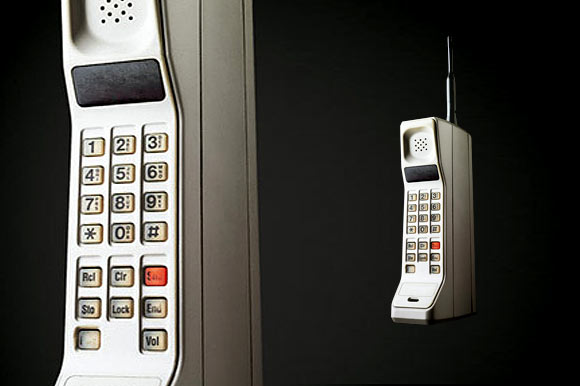
If you weren't already aware of this, new cellular phones are totally lame. That expensive iPhone or Nokia N90, and the heinous bluetooth dongle on your ear say only one thing: douchebag.
No, no. Why spend $400 on a brand-new phone when you can spend nearly $200 on a Motorola Dynatac, the first cellular phone that one person could lift alone. Retrobrick.com will sell them to you for only around a hundred pounds: not bad considering that they cost around $4000 in the early '80s.
Ok, I am not that elite. I can't quite get down with an expensive phone that only runs on an obsolete technology -- but I have gone back about half a decade, to the Nokia 3390, a classic GSM dual-band phone with a glorious green-screen monochrome display. No BS .5 megapixel camera, no stupid screen savers or background that makes the text unreadable. Just telephone and text messaging. Sure, it's no DynaTac, or even MicroTac for that matter, but it's not a bad backgrade.
Friday, January 25, 2008
I am so l33t it hurts
 Ok, so even I would have to admit that this is a fairly trivial side of computational aesthetics -- how your machine looks. However, I couldn't resist designing my own "skin" for the new laptop. In addition to being sick of seeing just how quickly the white plastic was scratching, there's a certain utility in being able to tell your white laptop apart from the rest: I'm living very close to Cupertino now, and this is definitely Apple country.
So, I scanned in a page from Thomas Pynchon's V. and uploaded it to Unique Skins' skin-designer utility. Props to them for providing this service at the best price -- they undercut some of the other players in the "skins" business by about ten bucks.
If you're not hip to the skins (and why would you be unless you want people to know how cool you are just by looking at your iPod or, uh, MacBook) there is a thriving business of printing images on pre-cut slices of 3m ControlTac, which is a removable, non-gooey self-adhesive vinyl. There are a bunch of people doing this: GelaSkins, which specializes in images from hip graffiti- or anime-inspired artists, MacVatar, which is obviously Mac-oriented, and Skinit, which seems to serve more plebeian tastes...as well as dozens of others. They protect the finish of your new (disposable in three-five years) laptop investment, but mostly allow you to modify the appearance without spending a lot of cash, adding a bulky shell, or voiding your warranty.
Well, that will end the commercial messages for the day.
Nerd note: this is the place where Pynchon claims that the classic WWII-era graffito, the Kilroy, was derived originally from a band-pass filter; this ties into my obsession with the
history of computing, and WWII's influence in pushing the computer to the prominence it has today. Plus I think the band-pass Kilroy looks rockin'.
Wednesday, January 23, 2008
The Vacuum Brew
Long time. Even faithful readers have no doubt left the inevitable withdrawal period caused by a lack of my ruminations; perhaps a few have, like mice once addicted to cocaine, continued to grab this page once in awhile. No matter: an update has arrived.
Over the winter break, an excursion that took me back to Brooklyn for the first time in several years, I had a chance to sample the nectar from a vacuum brewing device owned by the illustrious Keith Polasko of Split the Lark, who, in addition to being perhaps the best singer/songwriter left alive since the untimely self-instantiated death of Elliot Smith, is an aficionado of a beverage often considered merely quotidian: coffee.
In his apartment (littered with all sorts of amazing objects; in addition to his musical pursuits, he is an avid collector of most things arcane or obscure) there sits a modern stainless-steel Cuisinart drip brewer, unused, atop the refrigerator. It has been upstaged completely by a Yama vacuum brewer, a technology which, though perhaps older, is generally considered to deliver a superior brew. I'll admit that I sat and stared at the thing during its entire cycle: I'd never seen it before. The water slowly boils in the lower chamber, until the upper chamber is almost filled; then, you take it off the heat and the vacuum in the sealed lower chamber sucks the water back down, leaving the grounds.
It's a brew favored by connoisseurs; the new Blue Bottle Cafe in San Francisco has just installed a bar so they can serve it. Although it doesn't have the "set it and forget it" ease of a drip machine, it certainly has more panache, and the brew is certainly better than most drip machines: it's effectively unfiltered for better body, with no stripping of aromatic compounds, and maintains close to the perfect brewing temperature for better extraction. Most drip machines don't get hot enough for proper extraction, which is fine if you're using bitter, mass-produced, pre-ground stuff, but means that you're missing out on some of what your locally-roasted microlots have to offer.
Although I start my day with espresso, I have been enjoying brewed coffee myself. I brought a bag of Ethiopian Idido Misty Valley home-roast with me when I headed east, which, when brewed drip or single-cup, had a much fruitier profile than I'd gotten from the espresso machine. I had to admit that I enjoyed it quite a bit more brewed. Brewed coffee also tends to have a flavor shift as it cools; sometimes for the worse, often just...different. Like seeing more facets of a gem. Although I'm still partial to espresso (at 9 bars of pressure, you get things out of the beans that don't appear at one atmosphere) brewed coffee is certainly better for single-origin coffees that have a "delicate" profile: usually more acidic coffees with more fruit, less body, and floral aromatics, which are roasted lighter.
So I've been making some pots of press, and secretly lusting after a Yama. More gear is the last thing I need, of course, but there's something awfully charming about that siphon.
Over the winter break, an excursion that took me back to Brooklyn for the first time in several years, I had a chance to sample the nectar from a vacuum brewing device owned by the illustrious Keith Polasko of Split the Lark, who, in addition to being perhaps the best singer/songwriter left alive since the untimely self-instantiated death of Elliot Smith, is an aficionado of a beverage often considered merely quotidian: coffee.
In his apartment (littered with all sorts of amazing objects; in addition to his musical pursuits, he is an avid collector of most things arcane or obscure) there sits a modern stainless-steel Cuisinart drip brewer, unused, atop the refrigerator. It has been upstaged completely by a Yama vacuum brewer, a technology which, though perhaps older, is generally considered to deliver a superior brew. I'll admit that I sat and stared at the thing during its entire cycle: I'd never seen it before. The water slowly boils in the lower chamber, until the upper chamber is almost filled; then, you take it off the heat and the vacuum in the sealed lower chamber sucks the water back down, leaving the grounds.
It's a brew favored by connoisseurs; the new Blue Bottle Cafe in San Francisco has just installed a bar so they can serve it. Although it doesn't have the "set it and forget it" ease of a drip machine, it certainly has more panache, and the brew is certainly better than most drip machines: it's effectively unfiltered for better body, with no stripping of aromatic compounds, and maintains close to the perfect brewing temperature for better extraction. Most drip machines don't get hot enough for proper extraction, which is fine if you're using bitter, mass-produced, pre-ground stuff, but means that you're missing out on some of what your locally-roasted microlots have to offer.
Although I start my day with espresso, I have been enjoying brewed coffee myself. I brought a bag of Ethiopian Idido Misty Valley home-roast with me when I headed east, which, when brewed drip or single-cup, had a much fruitier profile than I'd gotten from the espresso machine. I had to admit that I enjoyed it quite a bit more brewed. Brewed coffee also tends to have a flavor shift as it cools; sometimes for the worse, often just...different. Like seeing more facets of a gem. Although I'm still partial to espresso (at 9 bars of pressure, you get things out of the beans that don't appear at one atmosphere) brewed coffee is certainly better for single-origin coffees that have a "delicate" profile: usually more acidic coffees with more fruit, less body, and floral aromatics, which are roasted lighter.
So I've been making some pots of press, and secretly lusting after a Yama. More gear is the last thing I need, of course, but there's something awfully charming about that siphon.
Subscribe to:
Posts (Atom)